
Question:
While reading the Confucian classics, I noticed the concept of “virtue.” However, despite my efforts to study it, different sources present inconsistent interpretations. Therefore, I am eager to find the most accurate answer. Specifically, I would like to know which virtues are called the “five virtues” in Confucianism.
—- Asked by Kitty
Answer:
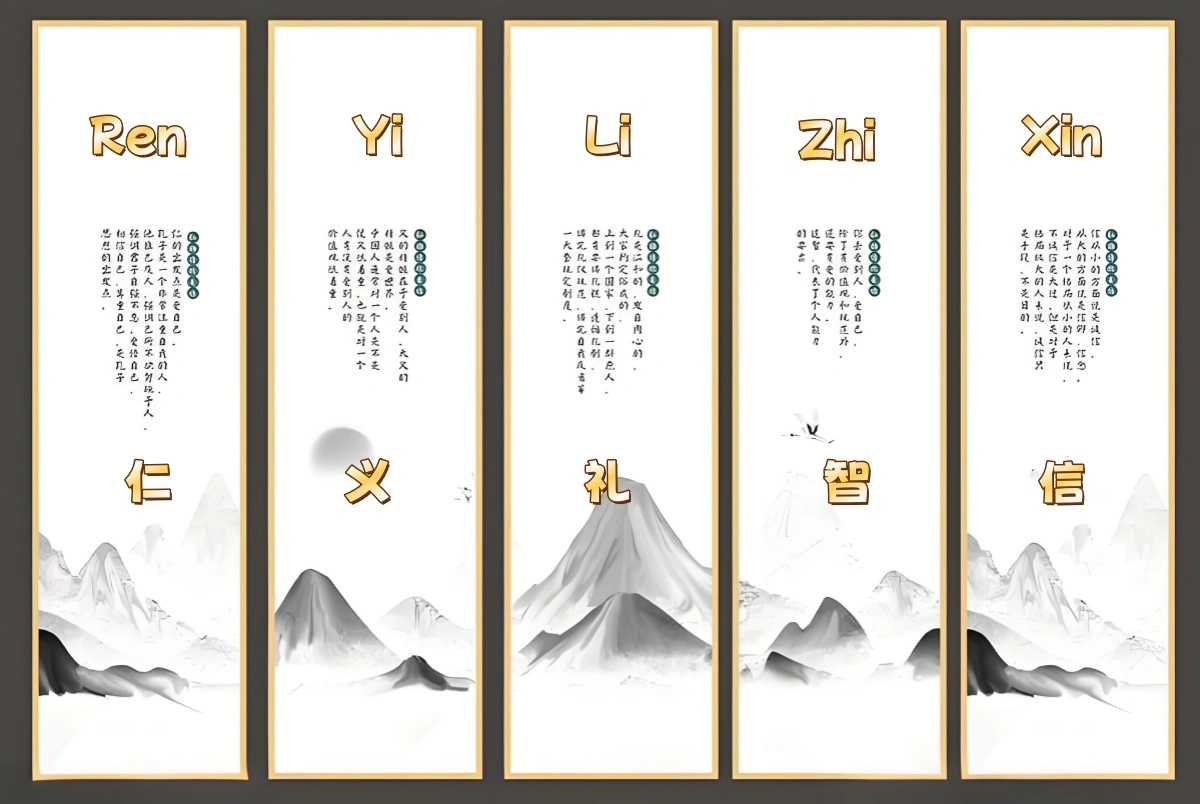
In Confucianism, the “five virtues” usually mean the Five Constant Virtues (Wu Chang, 五常). In pinyin, they are often written as Ren Yi Li Zhi Xin: Ren (仁), Yi (义), Li (礼), Zhi (智), and Xin (信). These five are widely used as a basic guide for self-cultivation and everyday ethics.
Confucianism also talks about many other virtues, including filial piety and loyalty. Here, “five virtues” refers specifically to the Five Constants.
The Five Constant Virtues at a Glance
Ren Yi Li Zhi Xin is the common pinyin order for the Five Constant Virtues (Wu Chang, 五常).
| Chinese (Simplified) | Traditional Chinese | Pinyin | Common English |
|---|---|---|---|
| 仁 | 仁 | Ren | Benevolence |
| 义 | 義 | Yi | Righteousness |
| 礼 | 禮 | Li | Propriety |
| 智 | 智 | Zhi | Wisdom |
| 信 | 信 | Xin | Trustworthiness |
Among them, Ren emphasizes love, care, and tolerance in interpersonal relationships. It advocates cultivating benevolence and love to resolve conflicts, thereby promoting social harmony, stability, and sustainable development.
Yi emphasizes moral principles such as integrity and justice. It requires people to uphold justice in decision-making.
Confucianism believes that whether a person’s behavior is morally appropriate is an essential criterion for evaluating their moral character. Adhering to justice can help shape people’s integrity and maintain social fairness and order.
Li covers all aspects of social life as an integral part of Confucian culture. From the rituals and norms of daily life to the rules and regulations at the national level, all embody propriety.
Confucianism stresses that everyone should respect and observe etiquette to promote personal cultivation and maintain social order.
Zhi focuses on rational thinking and attaches importance to people’s knowledge and decision-making capability.
According to Confucianism, a wise person can distinguish between right and wrong and deal with various complicated problems. Through continuous learning and thinking, people can promote their wisdom and better adapt to social development and changes.
Xin values moral qualities like honesty, trustworthiness, and mutual trust. According to Confucianism, it is easier for a person to gain a foothold in society with creditability. By adhering to Xin, people can build reliable social relationships and earn the respect and trust of others.
In short, these five virtues are essential for Confucianism as they guide people to pursue morality in daily life and realize social harmony and development.
Are the Five Virtues the “pillars” of Confucianism?
In English, people sometimes call the Five Constant Virtues the “pillars” of Confucianism. This wording is a convenient way to say that these five ideas are central, but it is not a fixed classical label.
If you want the more standard name, many sources call them the Five Constant Virtues or simply the Five Constants (Wu Chang, 五常). The reason they are often seen as “pillars” is practical: they offer a compact framework that links personal character to everyday ethics and social life.
FAQs
A: In modern summaries, Confucian virtues are sometimes listed as an 11-item set: Ren (仁), Yi (义), Li (礼), Zhi (智), Xin (信), Yong (勇), Shu (恕), Cheng (诚), Zhong (忠), Xiao (孝), and Ti (悌). For brief explanations of each, see our guide to Confucian beliefs and values.
A: The five core virtues are commonly known as the Five Constant Virtues (Wu Chang, 五常): Ren (仁), Yi (义), Li (礼), Zhi (智), and Xin (信).
A: “Ren Yi Li Zhi Xin” (仁义礼智信) is an important part of Confucian thought. It brings together five key moral ideas in Confucian ethics. It is also used as a traditional virtue formula for self-cultivation and everyday conduct. In many introductions, it is presented as the Five Constant Virtues (Wu Chang, 五常).
A: It is a traditional Confucian virtue phrase (仁义礼智信). In practice, it is commonly used as shorthand for the Five Constant Virtues (Wu Chang, 五常), listing the five virtues in order: Ren (仁), Yi (义), Li (礼), Zhi (智), and Xin (信).
A: “Pillars” is a modern English way of saying they are central. A more standard name is the Five Constant Virtues (Wu Chang), and Confucianism also includes other important virtues beyond these five.
Leave a Reply